LIC Jeevan Raksha 894 is a term insurance plan designed to provide financial protection to your family if you die during the policy term. It offers basic life cover from ₹5 lakh to ₹24 lakh, with a choice of regular premiums, payment for 10 or 15 years, or a single upfront premium.
The plan became available from 7 September 2026. Its Unique Identification Number is 512N368V01. This guide explains eligibility, premiums, death benefits, the optional accident rider and the conditions that matter when buying or discontinuing the policy.
Know this before buying: Jeevan Raksha is a pure risk plan. There is no maturity payout, return of premiums on survival, bonus or investment account. The premium pays for insurance protection. Certain single and limited-premium policies may qualify for an Unexpired Risk Premium Value on early exit, subject to conditions; this is not a maturity benefit.
Table of Contents
| Feature | Plan details |
|---|---|
| Type of policy | Non-participating, non-linked, individual life, pure risk plan |
| Plan number / UIN | 894 / 512N368V01 |
| Entry age | 18 to 45 years, age last birthday |
| Age at end of cover | Minimum 33; maximum 60 years, age last birthday |
| Basic Sum Assured | ₹5 lakh to ₹24 lakh per life under this plan |
| Policy term | 15 to 42 years; minimum 20 years for the 15-year premium-paying option; subject to cover ending by age 60 |
| Premium payment | Single; limited payment for 10 or 15 years; or regular payment throughout the policy term |
| Payment frequency | Yearly or half-yearly for regular and limited premiums |
| Minimum instalment | ₹2,000 for regular/limited premiums, excluding rider premium and underwriting extras |
| Maturity benefit / bonus | None |
| Optional rider | LIC’s Accident Benefit Rider for regular and limited-premium policies |
| Loan / paid-up value | Not available |
An applicant must be between 18 and 45 years old on their last birthday. The chosen term must end by age 60. The 42-year maximum term therefore applies only to an eligible younger entrant; a person aged 40 can choose no more than 20 years, and someone aged 45 no more than 15 years.
Basic Sum Assured starts at ₹5 lakh. It can increase in steps of ₹50,000 up to ₹7 lakh and in steps of ₹1 lakh above ₹7 lakh. The combined Basic Sum Assured across all Jeevan Raksha policies on the same person cannot exceed ₹24 lakh. Buying multiple policies under this plan does not increase that limit.
Acceptance and the final premium remain subject to LIC’s underwriting. Disclose smoking habits, health, occupation and existing insurance accurately. Separate rates apply for male and female lives, and for smokers and non-smokers. Risk starts from policy issuance after acceptance, as recorded in the policy schedule; submitting a proposal alone does not establish cover.
| Option | How long you pay | Minimum policy term |
|---|---|---|
| Regular premium | Throughout the policy term | 15 years |
| Limited premium — 10 years | 10 years | 15 years |
| Limited premium — 15 years | 15 years | 20 years |
| Single premium | Once at the outset | 15 years |
For every option, the maximum policy term is 42 years, subject to the maximum cover-ceasing age of 60. The policy term is how long base life cover lasts; the premium-paying term is how long premiums are due. These can be different.
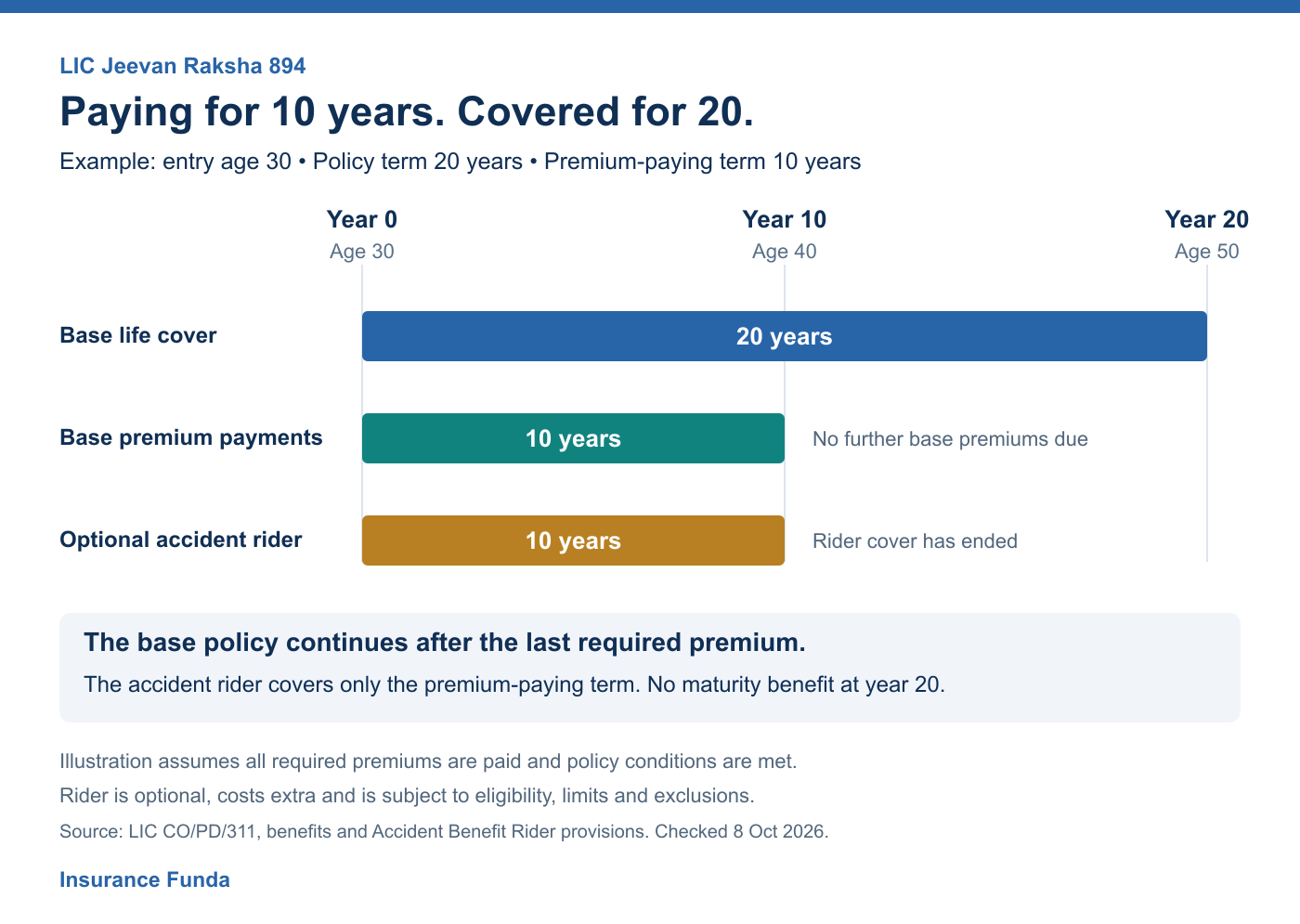
For example, a 30-year-old choosing a 20-year policy with a 10-year premium-paying term pays the scheduled base premiums for 10 years. If all required premiums have been paid and policy conditions are met, base cover continues for the full 20 years. The optional accident rider has a shorter duration in this example, as explained below.
Estimate yearly or half-yearly base premiums for regular payment throughout the policy term. This calculator is for purchase through an LIC agent. Choose your age, cover, sex and smoking status. The calculator applies the relevant rebates and checks the ₹2,000 minimum instalment. Limited-payment, single-premium and rider quotations are not included.
The following figures are for a male non-smoker, standard life, ₹5 lakh Basic Sum Assured and a 20-year policy term. Regular and limited-payment figures are annual premiums; the single-premium figure is paid once. These base premiums match LIC’s published illustration and the plan’s rate annexure.
| Entry age | Regular: yearly | Limited 15 years: yearly | Limited 10 years: yearly | Single: once |
|---|---|---|---|---|
| 20 | ₹2,290 | ₹2,555 | ₹3,150 | ₹19,035 |
| 30 | ₹2,730 | ₹3,070 | ₹3,825 | ₹23,805 |
| 40 | ₹4,435 | ₹5,035 | ₹6,390 | ₹41,770 |
The figures exclude rider premiums, underwriting extras and taxes, if applicable. No online-sale rebate has been applied. Female lives, smokers, other cover amounts and different terms require their own quotation. A single premium should not be compared directly with one annual premium: the payment timing and number of payments differ.
For regular and limited premiums, the half-yearly amount is based on the annual equivalent premium after applicable rebates, increased by 2% and divided by two. However, each instalment must meet the ₹2,000 minimum, excluding the rider and underwriting extras.
For the age-30 regular-premium example, ₹2,730 × 1.02 ÷ 2 = ₹1,392.30 before rounding. That is below the minimum, so the same parameters do not qualify for half-yearly payment. The applicant must choose an eligible combination of cover, term, payment option or payment frequency. Monthly and quarterly premium payment are not offered.
For an admissible death claim during the policy term, after risk has commenced and while the policy is in force, LIC pays the death benefit under the selected premium option. The policy’s exclusions and any applicable deductions still apply.
| Payment option | Base death-benefit calculation |
|---|---|
| Regular or limited premium | Higher of Basic Sum Assured and 7 times Annualised Premium, with a minimum of 105% of Total Premiums Paid up to death |
| Single premium | Higher of Basic Sum Assured and 125% of the Single Premium |
Annualised Premium excludes taxes, rider premiums, underwriting extras and modal loadings. Total Premiums Paid refers to premiums under the base product, excluding extra premium and taxes. The Single Premium used in the benefit calculation excludes taxes, rider premiums and underwriting extras.
Example: For the age-30 regular-premium illustration, seven times the annualised premium is ₹19,110. This is lower than ₹5 lakh, so the Basic Sum Assured determines the benefit, subject to the 105% floor and policy conditions. The formula does not mean ₹5 lakh plus seven times the premium.
No. If the insured survives to the end of the policy term, no maturity benefit is payable. The policy also does not participate in LIC’s profits, so it does not receive reversionary bonuses or other discretionary surplus additions. Anyone looking for savings accumulation or a survival payout should understand this distinction before choosing the plan.
LIC’s Accident Benefit Rider (UIN 512B203V03, or its applicable amended version) may be added for an extra premium to regular and limited-premium policies. It is not available with the single-premium option. For a qualifying accidental death, the rider sum assured is paid as a lump sum in addition to the base death benefit, subject to the rider’s definition of accident, exclusions and claim conditions.
The rider sum assured cannot exceed three times the base Basic Sum Assured. Rider premium must also remain within 30% of the base premium. LIC’s overall accident-cover limits across policies apply, including the ₹100 lakh aggregate limit and the separate Jeevan Shiromani allowance specified in the rider rules. These limits can restrict the amount actually available.
The rider lasts only during the base premium-paying term. With a 20-year base policy and premiums payable for 10 years, accident rider cover is available during those 10 years, while the fully paid base cover can continue for 20 years. The rider does not automatically last for the entire base policy term.
The rider can be selected at inception or an eligible policy anniversary, with at least five years of the relevant premium-paying term remaining, and before the policy anniversary at which the life assured’s age nearer birthday is 55. Read the separate rider terms before opting in.
The life assured can choose to have all or part of the death benefit paid in instalments over 5, 10 or 15 years. This choice must be made during their lifetime while the policy is in currency. The nominee cannot alter the option after death.
| Claim payment frequency | Minimum instalment |
|---|---|
| Monthly | ₹5,000 |
| Quarterly | ₹15,000 |
| Half-yearly | ₹25,000 |
| Yearly | ₹50,000 |
Instalments are payable in advance and calculated using LIC’s applicable interest rate. If the selected claim amount cannot support the minimum instalment, it is paid as a lump sum. Do not confuse monthly claim instalments with monthly premium payments: monthly premiums are not available under this plan.
The high-cover rebate is a percentage of the tabular premium and depends on entry age, cover band and premium option. The percentages below are premium rebates, not investment returns.
| Basic Sum Assured | Regular/limited: age 18–30 | Regular/limited: age 31–45 | Single: age 18–30 | Single: age 31–45 |
|---|---|---|---|---|
| ₹5 lakh to below ₹7 lakh | Nil | Nil | Nil | Nil |
| ₹7 lakh to below ₹10 lakh | 5% | 3% | 4% | 2% |
| ₹10 lakh to below ₹15 lakh | 10% | 6% | 9% | 5% |
| ₹15 lakh to below ₹20 lakh | 15% | 10% | 14% | 8% |
| ₹20 lakh to ₹24 lakh | 18% | 14% | 17% | 11% |
Exactly ₹7 lakh enters the second rebate band; exactly ₹10 lakh, ₹15 lakh and ₹20 lakh enter their respective higher bands. The calculator above applies the high-cover rebate for purchase through an LIC agent. Ask your agent for LIC’s final quotation to confirm the applicable premium and minimum instalment.
Yearly and half-yearly premiums have a 30-day grace period from the first unpaid premium due date. The policy remains in force during this period under its terms. If death occurs during grace, unpaid premiums and any balance premium recoverable up to the next policy anniversary are deducted from the claim as applicable.
If payment is not made within grace, the policy lapses and ordinary death cover ceases. Paying some premiums does not create a reduced paid-up life cover: this plan has no paid-up value. An eligible limited-premium policy may still have the separate Unexpired Risk Premium Value described below.
A lapsed regular or limited-premium policy may be revived within five consecutive complete years from the first unpaid premium, before maturity. Revival requires premium arrears, interest and evidence of continued insurability as required by LIC. It takes effect only after LIC approves it and issues the revival receipt. Rider revival is considered with the base policy.
The plan has no conventional surrender value. However, an Unexpired Risk Premium Value (URPV), if positive, may be payable in specified cases. It reflects the plan’s prescribed calculation for unused risk cover; it is not a refund of every premium paid.
| Premium option | Early-exit position |
|---|---|
| Regular | Nothing payable on surrender |
| Single | URPV, if any, may be payable on surrender during the policy term |
| Limited 10 or 15 years | URPV, if any, is available only after at least three consecutive full years of premiums have been paid |
For an eligible in-force limited-premium policy, surrender ends the policy when URPV is paid. For an eligible lapsed limited-premium policy, URPV may be payable on the earliest of death during the revival period, surrender during that period, or expiry of the revival period without revival. This does not restore the full death benefit of a lapsed policy.
The calculation depends on the payment option, original term, elapsed duration, premiums paid and applicable premium-rate factors. Obtain a policy-specific quotation before discontinuing. There is no policy loan facility.
A policyholder who disagrees with the terms may return the policy within 30 days of receiving the electronic or physical policy document, whichever is earlier, stating the reasons. The refund is subject to deductions for proportionate risk cover, medical examination expenses and stamp duty. Free-look cancellation is different from surrender later in the term.
Under regular and limited-premium policies, death due to suicide within 12 months of risk commencement or revival is subject to a special benefit of 80% of premiums paid to the date of death, provided the policy is in force. For a single-premium policy, the corresponding first-12-month provision pays 80% of the single premium. Taxes, underwriting extras and rider premiums are excluded from these amounts; the clause does not apply to a lapsed policy.
Incorrect statements or withheld material information can affect a claim under the policy’s terms and applicable law. Complete the proposal carefully, including smoking and health disclosures. The optional accident rider has its own exclusions; the rider’s full wording should be read separately.
You can purchase Jeevan Raksha through LIC’s authorised agents/intermediaries. Agent/intermediary proposals for this plan are submitted through ANANDA. The policy cannot be backdated.
Before applying, confirm the desired life cover and end age, premium-paying term, smoking classification, payment frequency, rider duration and final premium. Record nomination details and keep the policy schedule accessible to your family. For background on naming a nominee, see our guide to nomination in life insurance policies; confirm the applicable nomination requirements with LIC. Limited and single-premium buyers should review their customised benefit illustration, including the applicable early-exit values.
Taxes, if applicable, and income-tax treatment depend on the law and the policyholder’s circumstances. Do not assume that every premium qualifies for a deduction or add a fixed tax percentage to the examples without checking the current quotation.
The plan may suit someone seeking a defined amount of life cover within ₹5 lakh–₹24 lakh and a choice of premium-payment periods, who understands that there is no survival payout. Limited payment may appeal to someone who wants premium obligations to finish before base cover ends; single payment removes future base-premium due dates but requires more money upfront.
Assess the cover against household expenses, outstanding loans, dependants’ future needs and existing insurance. Our guide to how much life insurance you need explains the starting points, and the Human Life Value calculator helps you estimate the amount using your own assumptions. The ₹24 lakh cap may be insufficient for some families, and cover ends by age 60. Someone needing higher cover, protection beyond age 60, or a maturity payout should compare suitable alternatives before deciding. The accident rider supplements qualifying accidental-death protection; it does not replace adequate base life cover.
No. The similar names refer to different plans. Match the plan number and UIN before using a premium table or benefit description. Insurance Funda’s older Jeevan Rakshak 827 article is a separate historical reference and does not describe Plan 894.
No. ₹24 lakh is the total Basic Sum Assured limit per person across policies issued under this plan, subject to underwriting.
No maturity benefit or return of premiums is payable on survival. Eligible URPV on early exit under certain payment options is a separate provision.
No. Regular and limited premiums can be paid yearly or half-yearly. Monthly instalments are available only as an eligible death-claim settlement option.
The Accident Benefit Rider covers only the base premium-paying term. Base life cover can continue for the remaining policy term after all required base premiums have been paid.
Do not assume so. Issuance, medical requirements and any extra premium depend on LIC’s underwriting and the applicant’s disclosures.
Product reference: LIC Central Office circular CO/PD/311 dated 31 August 2026 and its premium-rate annexures, cross-checked with LIC’s published product documents. Premium examples above use Annexure 1 rates for male non-smoker standard lives at ₹5 lakh cover and a 20-year term. Article checked on 8 October 2026.
Read the official LIC Jeevan Raksha product page, which provides the sales brochure, policy document and Customer Information Sheet. Keep the applicable policy and rider wording with your quotation. This Insurance Funda article is an independent explanation; the issued policy terms govern benefits and claims.
| Official LIC document | What to check |
|---|---|
| Jeevan Raksha sales brochure (PDF) | Product features, eligibility, sample premiums, benefits and exclusions. |
| Jeevan Raksha policy wording (PDF) | Full contract definitions, benefit conditions, revival, early exit and exclusions. |
| Customer Information Sheet (PDF) | A concise overview to read alongside the policy document. |
This post was last modified on October 8, 2026 12:05 pm
LIC New Cancer Cover 908 explained with a premium calculator, level and increasing cover, early… Read More
LIC Health Shield 907 explained with eligibility, family coverage, benefit limits, premium examples, no-claim increases,… Read More
LIC New Jeevan Dhara II Plan 892 explained: compare all 11 pension options, early premium… Read More
LIC bonus rates 2026 explained with plan-wise tables, Jeevan Labh and Umang slabs, FAB, loyalty… Read More
LIC’s Bima Platinum (Plan No. 770, UIN: 512N397V01) is a close-ended, limited-premium life insurance plan… Read More
LIC’s Bima Lakshmi (Plan No. 881) is a revolutionary women-centric, guaranteed-return plan that blends security,… Read More