

LIC New Cancer Cover 908: Premium Calculator, Benefits & Examples
LIC New Cancer Cover 908 pays fixed cash benefits when the insured person is diagnosed with a specified early-stage or major-stage cancer. An eligible early-stage claim provides a lump sum and temporary premium waiver. An eligible major-stage claim provides a larger lump sum and monthly income for ten years.
The plan became available from 19 October 2026. Its Unique Identification Number is 512N370V01. This guide helps insurance agents explain the cover options, age-wise eligibility, premiums, benefit calculations and important claim conditions, with a calculator and practical examples.
Table of Contents
What kind of insurance is LIC New Cancer Cover 908?
It is a non-linked, non-participating, individual pure risk health insurance plan. There is no investment fund, bonus or maturity payment. The benefit amount follows the policy formula and the qualifying diagnosis, rather than the actual treatment bill.
Understand the distinction: a reimbursement health policy generally pays eligible medical expenses within its limits. Cancer Cover provides predetermined cash benefits that can help with the wider financial disruption of cancer, including loss of income. It covers specified cancers and stages; it is not comprehensive hospital insurance for every illness.
LIC New Cancer Cover 908: key features and eligibility
| Particular | Plan 908 rule |
|---|---|
| Entry age | 18–65 years, age last birthday |
| Policy term / premium-paying term | 10–15 years; premiums normally payable throughout the term |
| Maximum cover-ceasing age | 75 years |
| Basic sum assured | Age-specific minimum; maximum ₹50 lakh, in ₹1 lakh steps |
| Aggregate basic cover | ₹50 lakh across existing Plan 908 policies and current proposals |
| Benefit options | Option I: level cover; Option II: increasing cover |
| Premium frequency | Yearly or half-yearly |
| Premium guarantee | Premiums guaranteed throughout the policy term |
| Maturity / separate death benefit | None |
| Surrender / paid-up value / loan | None |
The maximum cover-ceasing age is an upper limit, not a promise of cover until 75 for everyone. A person joining at 35 for 15 years finishes the policy term at 50. At entry age 65, the available term is 10 years.
Minimum basic cover depends on entry age
| Age last birthday | Minimum basic sum assured |
|---|---|
| 18–34 | ₹35 lakh |
| 35–40 | ₹30 lakh |
| 41–50 | ₹20 lakh |
| 51–65 | ₹15 lakh |
For example, a 30-year-old cannot choose ₹15 lakh merely because that amount appears as the plan’s lowest minimum. The minimum for that age is ₹35 lakh. These are basic-cover limits; the scheduled increase under Option II is explained below.
Level cover or increasing cover: how do the options differ?
Option I — Level Sum Assured: the basic sum assured remains unchanged throughout the term. A ₹50 lakh policy therefore uses ₹50 lakh as its applicable sum assured, subject to the policy’s benefit rules.
Option II — Increasing Sum Assured: each of the first five policy anniversaries adds 10% of the original basic sum assured. This is simple growth, not compounding. Without a specified cancer diagnosis, ₹50 lakh becomes ₹55 lakh, ₹60 lakh, ₹65 lakh, ₹70 lakh and finally ₹75 lakh, then stays at that level.
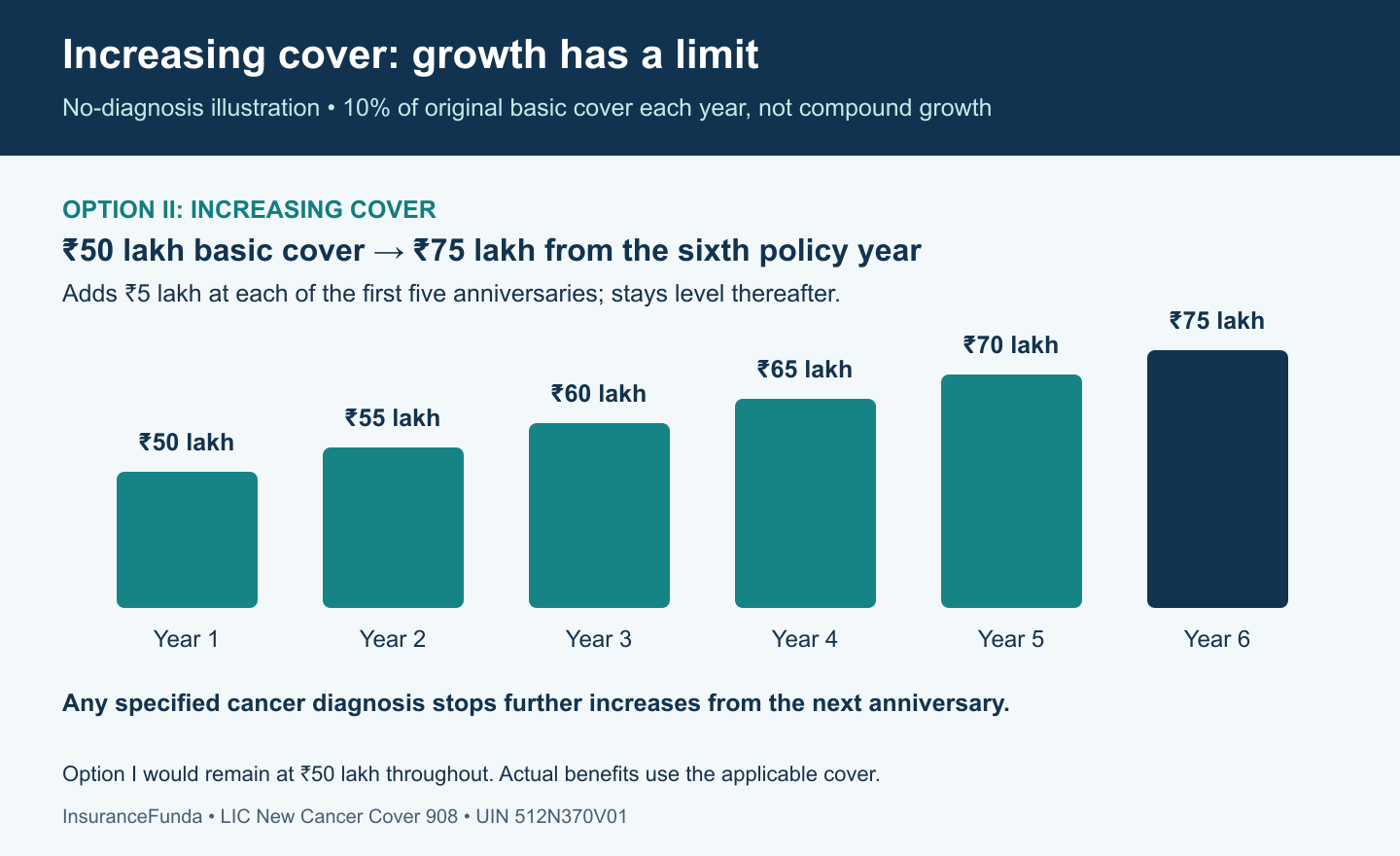
A diagnosis freezes future increases. If a specified cancer is diagnosed while the applicable cover is ₹60 lakh, increases stop from the next policy anniversary. The cover does not keep growing to ₹75 lakh after that diagnosis. The option is selected at inception and cannot be changed later.
LIC New Cancer Cover 908 benefits explained
Early-stage cancer: 25% lump sum and premium waiver
An admitted first early-stage cancer claim pays 25% of the applicable sum assured. Premiums for the next three policy years, or the remaining term if shorter, are waived from the policy anniversary following diagnosis. Premiums resume after that waiver if the policy still has years to run.
Premiums falling due from diagnosis to the next policy anniversary are deducted from the claim amount. The waiver therefore does not necessarily start on the diagnosis date. Early-stage benefit is payable only once; a later early-stage cancer does not produce another 25% payment. Major-stage cover continues under the policy conditions.
Major-stage cancer: full lump sum plus ten years of income
An admitted major-stage claim pays 100% of the applicable sum assured, irrespective of any early-stage benefit previously paid. In addition, 1% of the applicable sum assured is paid on each policy month for ten years, following payment of the major-stage lump sum.
These are 120 monthly payments. They can continue beyond the original policy term. If the insured person dies while receiving this income, the remaining scheduled payments continue to the nominee. This continuing income is distinct from a separate death benefit, which the plan does not provide.
Future premiums cease from the policy anniversary following diagnosis. Premiums due between diagnosis and that anniversary may be deducted from the lump sum. After payment of the major-stage benefit, no further early-stage or major-stage claim is payable; the income obligation continues.
A ₹50 lakh benefit example
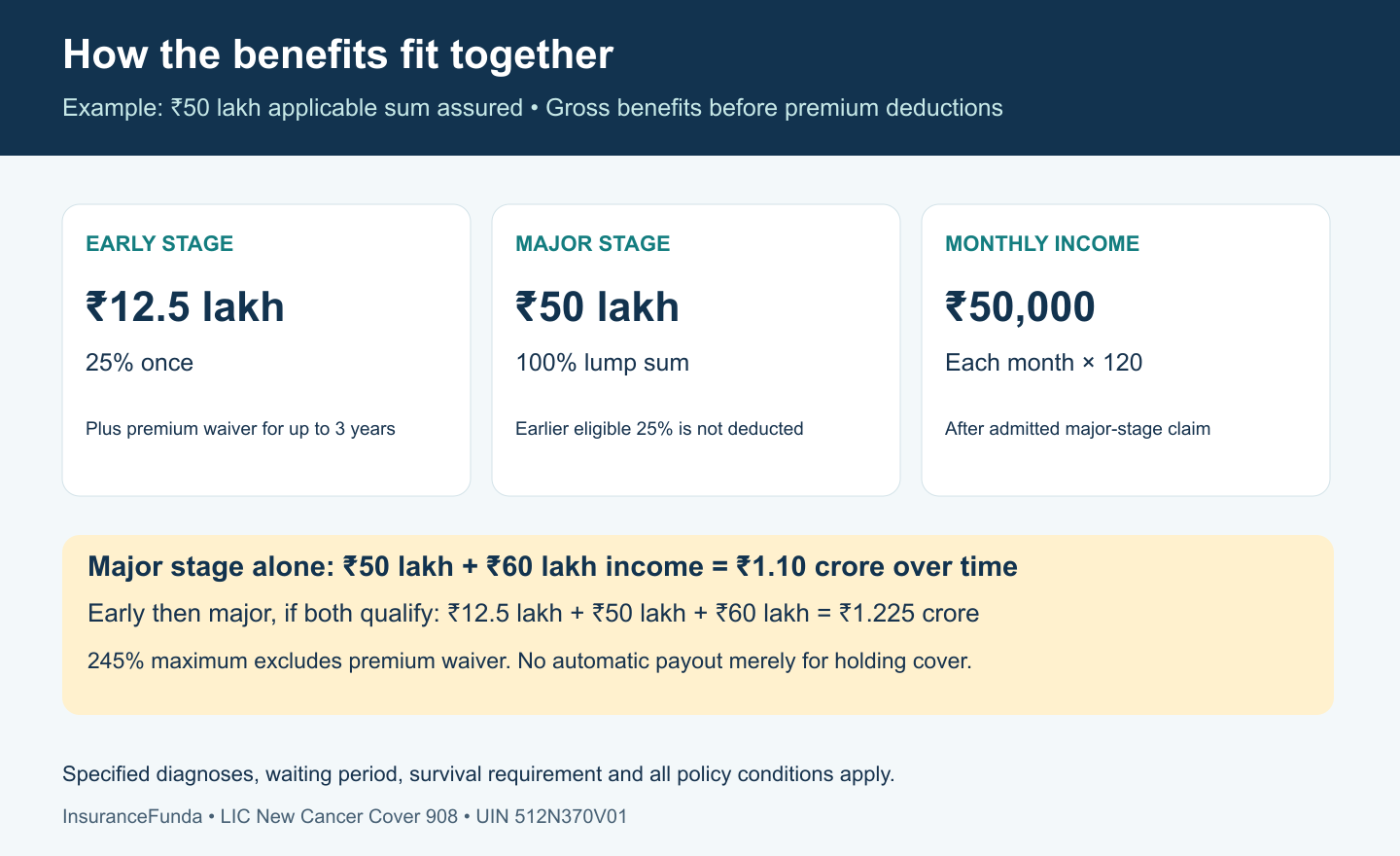
Assume ₹50 lakh applicable sum assured, an in-force policy, qualifying diagnoses and satisfaction of all waiting, survival and claim conditions. The figures below are gross benefits before any premium deductions.
| Scenario | Illustrated benefit |
|---|---|
| Early-stage claim only | ₹12.5 lakh plus the eligible premium waiver |
| Major-stage claim without an earlier early-stage claim | ₹50 lakh lump sum + ₹50,000 × 120 months = ₹1.10 crore over time |
| Early stage followed by major stage, both admissible | ₹12.5 lakh + ₹50 lakh + ₹60 lakh income = ₹1.225 crore over time |
The maximum aggregate claim benefit is 245% of applicable sum assured, excluding premium waiver. It comprises 25% early-stage benefit, 100% major-stage benefit and 120% monthly income. It is not a guaranteed return, and a major-stage claim alone does not generate the extra 25%.
For both stage benefits to qualify, early-stage cancer must have been diagnosed before major-stage cancer. If separate qualifying diagnoses are claimed together, separate medical evidence is required. Cancers diagnosed simultaneously do not automatically generate multiple payouts; the highest applicable stage benefit is paid under the simultaneous-diagnosis rule.
How much does LIC New Cancer Cover 908 cost?
The premium depends on entry age, sex, policy term, basic sum assured, benefit option and payment frequency. The following are LIC’s sample yearly premiums for ₹50 lakh basic cover, a 15-year term and offline purchase, excluding taxes, if any.
| Entry age | Option I: male | Option I: female | Option II: male | Option II: female |
|---|---|---|---|---|
| 20 | ₹4,950 | ₹6,100 | ₹5,700 | ₹7,400 |
| 35 | ₹9,100 | ₹17,600 | ₹11,400 | ₹23,400 |
| 50 | ₹32,800 | ₹41,600 | ₹44,750 | ₹55,950 |
| 60 | ₹89,150 | ₹66,750 | ₹1,23,450 | ₹90,150 |
Half-yearly instalments use 0.5090 × the applicable yearly premium, not simply half. This agent-focused calculator uses standard offline premiums.
Worked premium example: male, age 35, ₹50 lakh basic cover, Option I, 15 years, offline premium. Applying 0.5090 to the ₹9,100 yearly premium gives ₹4,631.90, rounded to ₹4,632 per half-year. Two instalments total ₹9,264 a year before any applicable taxes or extras.
LIC New Cancer Cover 908 premium and benefit calculator
Choose your age, sex, option, term, basic cover and payment frequency. Declare other Plan 908 basic cover and proposals so the combined ₹50 lakh limit can be checked. The calculator estimates standard-life new-business premiums and illustrates benefits; it does not assess medical eligibility or approve claims.
Waiting periods and exclusions to understand
| Condition | What it means |
|---|---|
| 180-day waiting period | Runs from issuance or the latest revival. Diagnosis of any stage of cancer during this period results in no benefit and policy termination. |
| Seven-day survival period | No benefit if death occurs within the specified seven days from diagnosis. The diagnosis date is included. |
| Specified definitions | The diagnosis must satisfy the policy’s cancer definition and medical-evidence requirements. |
| Pre-existing conditions | The exclusion covers the stated cancer, precancerous or related conditions diagnosed, advised on or treated within the 36-month look-back described in the policy. |
The 36-month wording defines a pre-existing-condition look-back. It does not mean every pre-existing cancer automatically becomes covered after three years. Revival restarts the waiting-period provisions; exclusions also apply. The brochure makes a specific exception at revival for an early-stage condition for which a claim was already admitted before lapse.
Specified early-stage conditions include carcinoma-in-situ and defined early prostate, thyroid and bladder cancers, chronic lymphocytic leukaemia and CIN3 on cone biopsy. Each has precise medical criteria. A general description such as “early cancer” alone does not establish eligibility.
Major-stage exclusions include specified non-invasive or less advanced tumours and stage thresholds. Other exclusions address conditions linked to alcohol or drugs, subject to the prescribed medical-direction exception, and nuclear contamination. These are selected explanations, not the complete exclusion wording. Read the official brochure and policy document before evaluating a particular diagnosis.
Premium breaks, cancellation and claims
Yearly and half-yearly premiums have a 30-day grace period. Cover remains in force during grace under the policy terms; unpaid premium and relevant premiums due before the next policy anniversary may be deducted from an admitted claim. If payment is not made before grace expires, the policy lapses and benefits cease.
Revival may be requested within five consecutive complete years from the first unpaid premium and before maturity, during the insured person’s lifetime. It requires LIC’s approval, evidence of continued insurability as required, and payment of arrears with applicable interest. Revival is not automatic.
There is a 30-day free-look period from receipt of the electronic or physical policy document, whichever is earlier. Cancellation refunds are subject to the prescribed deductions. The policy has no surrender value, paid-up value or loan facility.
From diagnosis to benefit payment
- Check cover and dates: confirm the policy is in force, diagnosis falls within the term and waiting and survival conditions are met.
- Identify the qualifying stage: the exact policy definition and supporting histology or other required evidence determine eligibility.
- Establish applicable cover: use the selected option and any increases already earned; account for a previous diagnosis freezing increases.
- Apply benefit limits and deductions: distinguish gross lump sum, premiums deductible, waiver timing and monthly income.
- Submit evidence to LIC: follow LIC’s current claim process and provide the required medical and policy records for assessment.
Fixed benefits still require evidence of the covered event. The size of a hospital bill alone does not establish the amount payable or claim eligibility.
Points to weigh before choosing LIC New Cancer Cover 908
The plan combines a defined lump sum with extended income support after a qualifying major-stage diagnosis. Its premium waiver and guaranteed premiums make the commitment easier to understand, while Option II provides a limited scheduled increase in cover.
The limitations matter too: only specified cancers qualify, waiting and survival conditions apply, cover ends after the selected term, and even increasing cover stops growing after five anniversaries or a specified diagnosis. There is no refund merely because no claim occurs. Consider the fixed benefit alongside existing reimbursement health cover, life insurance and emergency savings.
Frequently asked questions
Is LIC New Cancer Cover 908 the same as the earlier Cancer Cover plan?
This article and calculator concern New Cancer Cover, Plan 908, UIN 512N370V01. Older Cancer Cover articles and calculators may use different eligibility rules, rates or benefits. Match the plan number and UIN before comparing them.
Does an early-stage claim under LIC New Cancer Cover 908 reduce the later major-stage lump sum?
No. The eligible major-stage lump sum is 100% of applicable sum assured irrespective of an early-stage benefit previously paid. Premium deductions and other claim conditions still apply.
Does increasing cover rise by 10% every year forever?
No. It adds 10% of original basic cover on each of the first five anniversaries, up to 150% of basic cover. A specified cancer diagnosis stops subsequent increases.
Does monthly income stop when the insured person dies?
Once the major-stage income benefit has started, remaining scheduled instalments continue to the nominee. The plan does not separately pay a death benefit.
Does LIC New Cancer Cover 908 return premiums if there is no claim?
No maturity benefit or return of premiums is payable on survival to the end of this pure risk policy.
Is the LIC New Cancer Cover 908 premium eligible for a tax deduction?
Tax treatment depends on current law and individual circumstances, including the applicable tax regime. The calculator does not estimate tax deductions or exemptions. Check current rules before relying on a tax benefit.
Related Insurance Funda guides
For fixed hospital and surgical benefits covering eligible family members, read our LIC Health Shield 907 guide and calculator. For a separate explanation of life cover, see LIC Jeevan Raksha 894. These plans cover different events; their benefit amounts should not be treated as interchangeable.
Sources and scope
Prepared on 23 October 2026 using LIC’s New Cancer Cover product circular CO/PD/315 dated 12 October 2026 and its premium annexures, with key terms and sample premiums checked against the public sales brochure dated 14 October 2026. See the official LIC New Cancer Cover product page and LIC’s sales brochure.
This is an independent educational explanation. Examples assume an in-force policy, admissible diagnoses and satisfaction of the applicable conditions; they are not personalised quotations or claim approvals. The issued policy, underwriting terms and applicable documents govern individual cover and claims. Share this guide with fellow agents and readers who want to understand the plan.